When Do Photo Booth Leads Come In? What Four Years of Data Says About Timing Your Advertising
Most photo booth owners know their busy season by feel. Then the dates fill up, and it's too late to do anything about it. But the time customers book you and the time they actually ask about booking you are two different things. If you know when inquiries arrive, you know when your marketing needs to be working.
To find out, we looked at four years of website lead submissions from a photo booth and event entertainment business on the East Coast. These are all form fill submissions, quote requests sent through the website's forms, each with a date and time stamp. Leads that came in by phone call or text message were not included. The form leads came from all traffic sources: paid ads, organic search, and social media. Keep in mind these are leads, not bookings. Not every inquiry turned into a booked event, so this data shows when people reach out, not when they commit.
The Data
- 614 leads submitted from January 2022 through December 2025.
- Each lead was grouped by the month it came in, the day of the week, and the hour of the day(local time).
- The monthly figures combine all four years, so each bar is the total of four Januarys, four Februarys, and so on.
The volume grew each year, but this article isn't about growth. It's about timing : when people reach out, and what that tells you about when to advertise.
Month Of Year: Leads Have Two Seasons
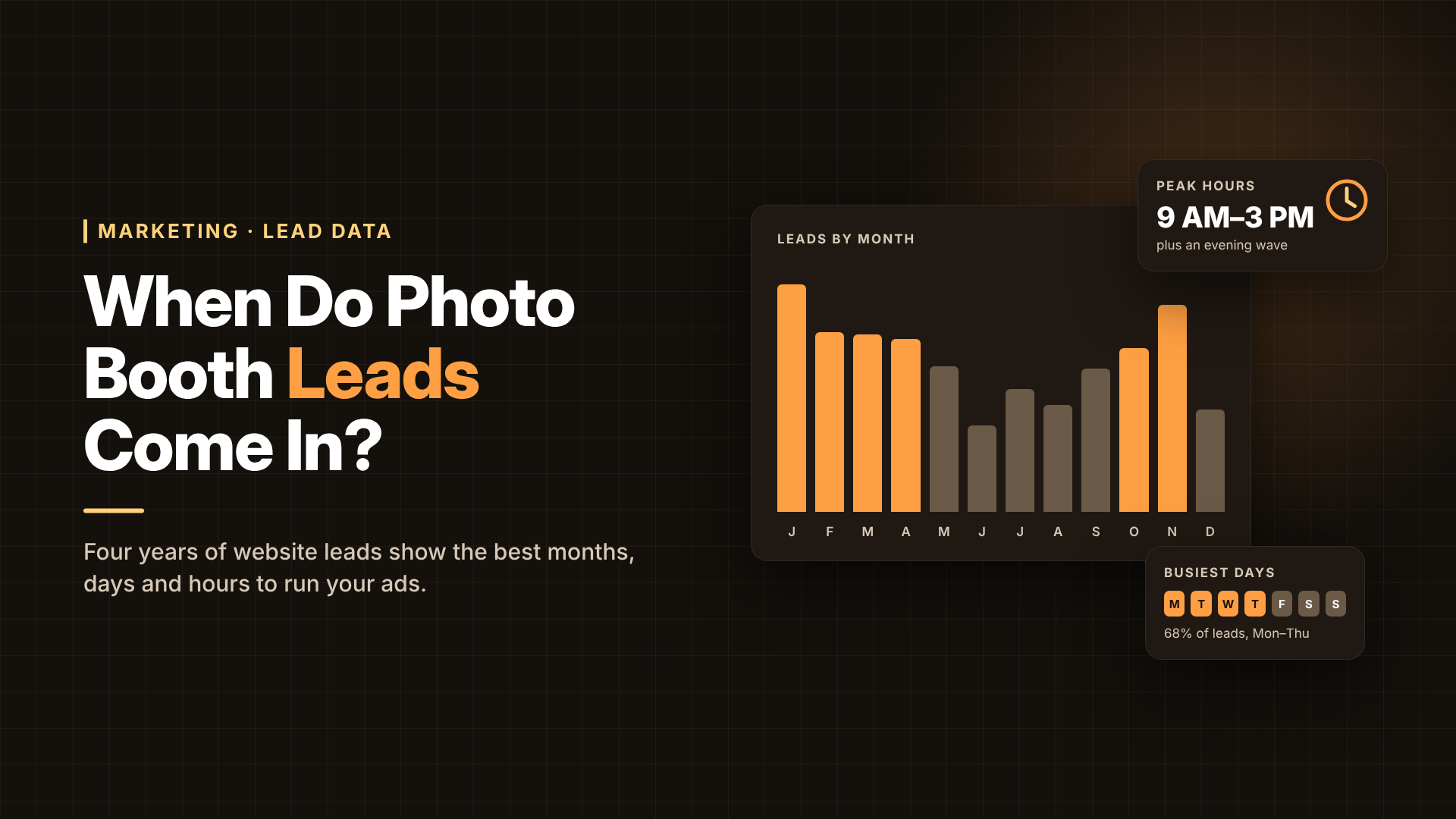
Website form leads, January 2022 to December 2025 (614 leads).
Leads don't arrive evenly through the year. They come in two waves, with a deep dip in the summer.
Wave one runs January through April. January is the single busiest month, and February through April stay well above average. Those four months alone account for about 41% of the year's inquiries. This lines up with engagement season: many couples get engaged between Thanksgiving and New Year's, then start booking vendors in the new year. Corporate planners are also setting budgets and booking spring events.
The summer is the slowest stretch. June is the lowest month of the year, and July and August stay below average. Customers are busy attending weddings, graduations, and vacations, not planning them. You're probably busy working events too.
Wave two runs September through November. Inquiries climb each month through the fall and peak in November, the second-busiest month of the year. That's when holiday parties get booked, and when couples planning for the following year start shopping.
December falls off sharply. It's the second-slowest month. People are busy with the holidays, and new inquiries largely wait until January.
The takeaway: your inquiries come months before your busy event dates. If your calendar is fullest in the summer and around the holidays, the requests for those dates arrived in the winter, spring, and fall.
Day Of Week: Leads Are A Weekday Activity
Website form leads, January 2022 to December 2025 (614 leads).
Photo booths are a weekend business, but booking one is a weekday task. Monday is the busiest day for inquiries, followed by Tuesday and Thursday. Monday through Thursday together bring in about two-thirds of all leads.
Friday and Saturday are the slowest days. That makes sense: those are the days people are at events, not planning them.
Sunday is the surprise. It rebounds to nearly the level of a midweek day. Sunday is a natural catch-up day, when people sit down to plan the week, work through wedding to-do lists, and send the inquiries they've been putting off. Some of that planning likely carries into the Monday peak, too.
Sunday hasn't always looked this strong. A previous analysis of this business's leads did not show Sunday performing nearly as well as it does now. That's a good reminder that these patterns can shift over time, so it's worth rechecking your own numbers every year or so instead of setting your ad schedule once and forgetting about it.
Time Of Day: Business Hours, Then A Second Wave After Dinner
Website form leads by hour submitted (local time), January 2022 to December 2025. Each bar covers one hour, e.g. 9a = 9:00 to 9:59 AM.
Almost nothing happens overnight. Inquiries start climbing around 7 AM and reach their first peaks at 9 AM and 11 AM. They stay strong through the early afternoon, with 2 PM and 3 PM nearly as busy as the morning.
There's a lull around 4 and 5 PM, when people are wrapping up work and commuting home. Then a second wave arrives in the evening, with 6 PM and 8 PM standing out. Roughly three in ten leads come in between 5 and 10 PM. After 10 PM, activity drops off quickly.
The pattern tells you who's reaching out. Daytime inquiries likely include corporate planners and people browsing during work breaks. The evening wave is couples and families planning together after dinner.
What This Means For Your Advertising
Knowing when leads arrive lets you put your ad budget where the demand is, instead of spreading it evenly and hoping for the best.
1. Plan Your Budget Around The Two Seasons
Think of your year in four phases:
| Period | What's Happening | What To Do |
|---|---|---|
| Late December | Inquiries are at a low, but engagement season is underway | Have your campaigns, landing pages, and offers ready. Start ramping up the last week of December. |
| January to April | The biggest inquiry season of the year | Spend your largest share of budget here. Don't let campaigns run out of daily budget in January. |
| May to August | Inquiries slow, bottoming out in June | Scale back, but stay visible. Shift efforts to optimizing your business and website, working on reviews, and social content from your events. |
| September to November | The second wave builds to a November peak | Increase spend from September. Promote holiday party and corporate packages, plus next year's wedding dates. |
One caution: don't turn advertising off completely in the slow months. Fewer people are searching, but the ones who are still need a booth. Slower months can also be cheaper, because many competitors pull back too.
2. Use Ad Scheduling For Days Of The Week
In Google Ads, you can use an ad schedule to raise or lower bids by day.
- Raise bids Monday through Thursday, when most inquiries come in.
- Keep Sunday strong. It's nearly as busy as midweek.
- Lower bids on Friday and Saturday, the two slowest days.
Lower the bids instead of turning those days off. You still want to show up for the people who are searching then. One note: if your campaigns use automated bidding, such as Maximize Conversions or Target CPA, Google ignores most ad schedule bid adjustments and sets bids itself. In that case, the schedule is still useful for reporting and for deciding when your team is available to respond.
3. Match Your Bids To The Hours People Inquire
- Bid highest from about 8 AM to 4 PM, when the majority of leads arrive.
- Keep the evening covered from 5 PM to 10 PM. About 30% of leads come in then, and these are often couples planning together.
- Lower bids late at night and in the early morning. Very few leads come in between 10 PM and 7 AM.
4. Make Sure Someone Can Respond
Timing your ads only helps if you respond quickly. The data shows when inquiries arrive, so plan your follow-up around it:
- Check for new inquiries first thing Monday morning, which is often the busiest day of the week.
- Have a plan for responding to evening and Sunday leads quickly, whether that's an auto-reply with your pricing guide or a text-back process.
- In January and November, make sure your follow-up can keep up with the volume.
The company that responds first often wins the booking.
Check Your Own Data
These patterns come from one business, so treat them as a starting point, not a rule. Keep in mind that this is a business on the East Coast, and results could vary in different parts of the country. Wedding season and weather patterns look different in Florida, Texas, or California than they do in the Northeast. This data is also from the U.S. only. Results could be different in other countries, where wedding seasons, holidays, and the work week follow a different calendar. Your market, your mix of weddings and corporate events, and your own advertising history all shape your numbers. A few things to keep in mind:
- Your leads reflect your ads. If you paused campaigns in a given month or ran them only during business hours, your lead data will show that, not just customer behavior.
- Different event types follow different calendars. Corporate holiday parties, school events, and weddings each have their own booking seasons.
- More years give a clearer picture. One year can be skewed by a single big promotion or a slow season.
You can pull the same view of your own business in a few minutes:
- Google Ads: In your campaign reports, segment conversions by Day of week and Hour of day, and compare months over the past two or three years.
- Your website forms: Export your form submissions with their date and time stamps, then sort them by month, weekday, and hour.
- Your CRM or booking software: Most systems can export the date each inquiry was created.
Final Thoughts
The busy season for your calendar isn't the busy season for your inbox. In this data, inquiries peaked in January and November, slowed down in the summer and December, arrived mostly on weekdays, and came in during business hours with a second wave in the evening.
If you advertise based on when your events happen, you'll often be a few months too late. Advertise based on when people are planning, and your budget will work a lot harder.
Have your own lead timing data to share? Post what you're seeing in the Photo Booth Magazine Facebook group.